momgineer: task cards
Showing posts with label task cards. Show all posts

STEM Challenge for Summer with Buoyancy - Design a Submersible

STEM Challenge for Summer: Design a Submersible!

This is one of the more challenge STEM activities I have done with kids over the years! It's also perfect for summer because you will get wet!

Warning: You WILL Get Wet with this STEM Challenge

Why try this challenge? I can't even tell you how many boat challenges I have done with kids, asking for a simple craft that floats, something that can be propelled with wind (sailboat), and so on.

You have probably also done "Does it sink or float?" activities with your students over the years.

This challenge is a combination of all those!

What if we want an object to not sink,

but to float,


but not at the surface and rather about halfway between the bottom of a body of water and the top?

Gather Materials for Submersible STEM

First, gather all materials needed for the challenge:

For the water:
You will need a tub, storage bin, kiddie pool, etc. for this challenge. You will also need to fill the bin with water.

Students can create their submersibles with aluminum foil, popsicle sticks, plastic egg carton pieces, balloons, rubber bands, recyclables, pennies or small weights, etc.

Your students can start in one of two ways:
  • With an object that floats, that they will need to make LESS buoyant.
  • With an object that sinks, that they will need to make MORE buoyant.

Go Deeper with Science in this STEM Challenge

Have your students research density and buoyancy. Ask:

How does the density of an object affect its buoyancy?

When might you want a water vessel to NOT be completely buoyant?

What skills do students work on? In addition to following the Engineering Design Process to complete this challenge, students will need to work together and may need to make several modifications to improve their sail designs.

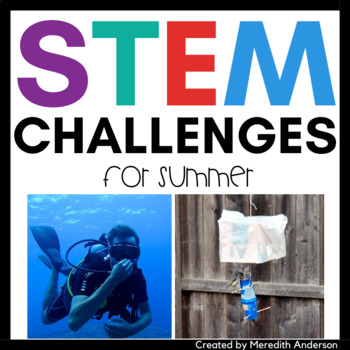
Add more rigor into this activity and download printables for students to use with the STEM challenge resource (or get the pack of Summer STEM challenges) on Teachers pay Teachers (also includes sand castle STEM and a squirrel proof bird feeder):


Pin these ideas for later:

9 Ways to Use Task Cards in the Classroom

Task Cards Can Be Used a Variety of Ways


Task cards have become a staple in the elementary classroom. They are so versatile for reinforcing learning; if you haven't tried them yet, I highly recommend them. They reusable year after year, so after you prep them once you are good to go storing them for the next year.

1. Use Task Cards at Your Centers

This is definitely one of the more obvious ways to use task cards. Prep your task cards on card stock, laminating if desired, and store in pouches or small containers. Provide blank paper for recording or use recording sheets that come with your task card resource. Students can work through the appropriate task cards to reinforce whichever concept you are currently working on.

2. Use Task Cards in Your Interactive Notebooks

This method will require that you print out multiple copies of your task cards, however then students can review them at any time! This is particularly helpful if you have ELA or Math INBs because students can then return to the cards to study for standardized testing. For a more detailed look at using task cards in interactive notebooks, visit this post.

3. Use Task Cards as a Whole Class Activity 

Use a document camera and work through the problems concurrently or together!

4. Use Task Cards to Host a Mini Quiz Bowl

Most task card resources come with a number of task cards. Split your class into teams of 3-4, use a document camera or project one card. Have a team "buzz in" to answer the question and keep score. Winning team gets bragging rights!

5. Use Task Cards to Play Scoot

If you haven't played SCOOT, Jenny has written a great post about it! Check it out here.

6. Use Task Cards for Homework

Assign 1-4 task cards, depending on difficulty and have students complete the cards at home.

7. Use Task Cards as Exit Slips

Do a quick check on student understanding and learning by using task cards as exit slips.

8. Use Task Cards for Early Finishers

Keep a variety of task card sets available, including ones that are at a "challenge" level for your students. If they have finished their work and could use a challenge, this is a great way to provide enrichment. If you are using task cards with QR code answers, these will even be self-checking. Read more about QR codes and task cards.

9. Use Task Cards as Sub Tubs or Sub Plans

You can have a variety of task cards in different subjects saved for a sub. When the inevitable stomach bug or flu rolls through the school (or through your own child's school), your sub plans will be ready to go!


Free Task Card Download

To get you started, this is one of my most popular free downloads! There are 16 task cards to get you started with a fun animal theme! These have been designed for 4th grade but will also work in 5th or as challenge cards in 3rd:


Quick Links to Other Popular Task Card Resources

All Task Cards

Task Cards for 1st Grade
Task Cards for 2nd Grade
Task Cards for 3rd Grade
Task Cards for 4th Grade
Task Cards for 5th Grade

Best Selling Task Cards! This is by far my most popular set of Fractions task cards:
https://www.teacherspayteachers.com/Product/Fraction-Task-Cards-Math-Review-for-4th-Grade-821799?aref=o815ctra&utm_source=Momgineer%20Blog&utm_campaign=9%20Ways%20to%20Use%20Task%20Cards%20-%204th%20fractions%20set

Yet another topic that seems to be difficult for students to master is equivalent fractions, but you can find those task cards here:
https://www.teacherspayteachers.com/Product/Equivalent-Fractions-Review-and-Test-Prep-Task-Cards-1372924?aref=sfmn88uk&utm_source=Momgineer%20Blog&utm_campaign=9%20Ways%20to%20Use%20Task%20Cards%20-%204th%20equiv%20fractions%20set


Pin these Task Card ideas for later:


How to Rock Your Math Block

When you hear the word FLUENCY what comes to mind? For most teachers, when we think about lessons related to fluency, we almost always think about reading fluency. We all know about the importance of reading fluency and its role in reading comprehension. But what about math fluency? What is it, why is it so important, and how do we help our students develop it? 


Math Fluency Broken Down

    Simply put, math fluency usually manifests itself in two forms: math fact fluency and math procedures fluency. When a student is ‘’fluent’’ in these areas, they can recall math facts and perform math operations with ease and automaticity. Because math skills are cumulative, it’s easy to see why activities (that are engaging & fun) that focus on and help to develop math fluency are so vital!  
    All teachers know how important it is to have students learn and practice math skills in various settings, such as in groups or independently. But it’s not always easy to find versatile math activities that lend themselves to both independent and group work. This set of task cards works well for both and has many engaging elements that will grab (and hold!) your student’s attention as they learn. Imagine their enthusiasm as they get to play the ever-popular SCOOT game while learning math! 

https://www.teacherspayteachers.com/Product/Fractions-Task-Cards-1984075

Math For Various Learning Styles

    As teachers, we are always looking for math resources that appeal to various learning styles, right? Chances are, your class list is comprised of a complex mixture of auditory learners, kinesthetic learners, and visual learners. The challenge is to find something that works for all of those learners. These math bingo games were created with all of those learning styles in mind! Every student wants to become fluent in their math skills so they can do well in the Math Bingo games! These game sets can be played in a variety of ways, ensuring that everyone’s a winner! 
Math Bingo Games Meredith Anderson - Momgineer

Stock Your Math Centers

    Speaking of variety, sometimes we get so busy with life, lesson planning, and all of our day-to-day teaching duties, that we forget to include lessons that include variety. Variety, in this case, relates to applying concepts and skills to many different math tasks. It’s worth remembering that when kids get to apply their knowledge and skills, especially math-related skills, to a wide array of activities and tasks, the retention level of those skills skyrockets dramatically! When we’re just too busy to create fabulous lesson plans, with tons of much-needed variety, here are some math resources that are perfect for filling that need! When you’re looking for activities to incorporate into your Math Centers, this large and lively bundle of math station activities will make your math center planning a breeze. There’s even a freebie with a demo to show you how the bundle of games work! 

More Math Games

https://www.teacherspayteachers.com/Product/Money-Games-629478?aref=xu0q1e32https://www.teacherspayteachers.com/Product/Halloween-Math-Printables-for-K-1-2140705


https://www.teacherspayteachers.com/Product/Math-Stations-BUNDLE-Addition-and-Subtraction-Shapes-Fractions-1631305?aref=6s2wgl5fhttps://www.teacherspayteachers.com/Product/3rd-Grade-Math-Year-Long-MEGA-BUNDLE-831524?aref=jph71d0g

Share Your Ideas

    What are your thoughts on math fluency, adding variety in lesson plans and activities, and planning activities for various learning styles? I’d love for you to take a moment and share your best practices in the comments area below (scroll way down)!

Using task cards in interactive math notebooks


Do you use task cards in your classroom? While they are great for math centers, you may not have a math station in your classroom. While they are fun for a game of Scoot, if you have a lot of students or a wide range in math abilities, a game might not be the best thing for your kids.

Interactive notebooks are a great way to build your own textbook. You can use task cards as homework (glue in 4 on Monday morning, and you have a problem for each night Mon-Thursday!) or begin your morning that way. If you are using INBs for morning work, you can give your students 5-10 minutes to complete their problem, and then swap notebooks with a neighbor and have them check their work.


Math Task Cards with a Beloved Story

I have created a set of Little Red Riding Hood word problem task cards that are sure to delight even your math-phobic kiddos. Word problems are absolutely essential to practice.

While it's important to understand math facts and concepts, you need to be able to apply them.


This is why most of my task cards are word problems!

Using a familiar story with a bit of humor goes a long way to connect mathematics with kids. They will also be practicing reading comprehension with word problems, which is why it might make sense to work in pairs: try a strong reader with a student who is strong in math!


If your students still need a lot of space to write out their ideas, try it out with one task card per page. Make sure they show their thought process and don't just take a guess!

If you print task cards smaller (these are at 2 pages per sheet, so you get 8 task cards on a page), you can fit two of them on a notebook page.

They are glued at the top, and then the page is creased down the center.

Each problem gets a column.

All of the steps are labeled in the margin, with the answer circled or boxed in at the bottom (don't forget the label!).


A variation on using two task cards per page is to make them a lift-the-flap tab. Using the outer margin as the flap to glue down, your students can then perform their calculations underneath the flap. I personally prefer the previous method because then you can refer to the problem easily while you work on it instead of flipping back and forth, but use whichever style works best for you!

All of the problems shown above are from the following resource Little Red Riding Hood Word Problem Task Cards for grades 2 & 3:

https://www.teacherspayteachers.com/Product/Word-Problem-Task-Cards-Grades-2-3--1953443